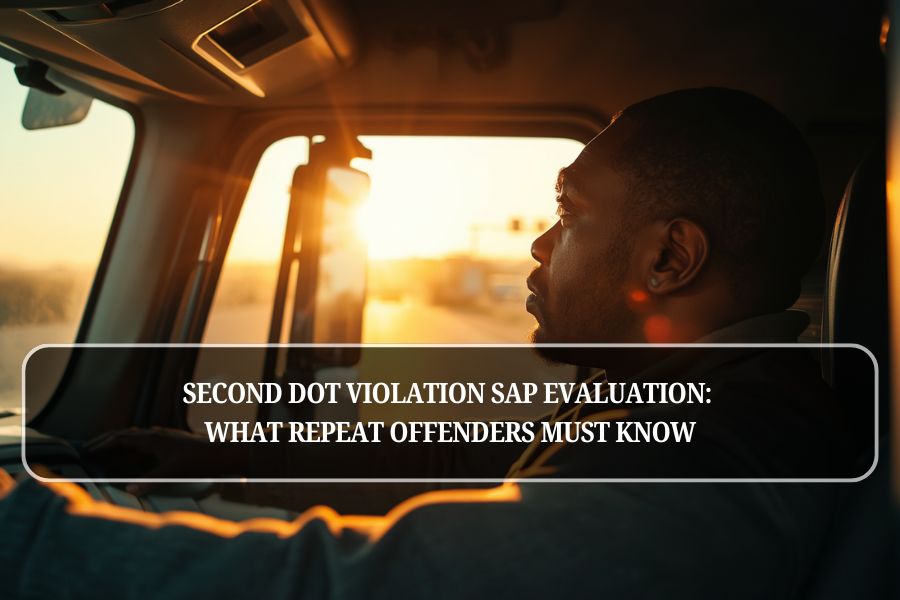
A second positive test does not erase your career. It does raise the stakes. A second DOT violation SAP evaluation follows the same federal framework as a first offense, but the margin for error shrinks fast. Employers watch closer. Follow-up testing runs longer. The FMCSA Clearinghouse flags your file differently.
This guide breaks down what actually changes after a repeat offense, what stays the same under 49 CFR Part 40, and how the DOT SAP Program applies to drivers who find themselves back at square one. Whether you work out of Atlanta, Decatur, or Marietta, the path back to safety-sensitive duty starts with understanding these rules before your next appointment.
What Counts as a Second DOT Violation
A DOT drug and alcohol regulation violation includes a verified positive drug test, an alcohol test showing a concentration of 0.04 or higher, a refusal to test, or any other breach of the prohibition on substance use while performing safety-sensitive functions. A second violation simply means this has happened before, whether with the same employer or a different one.
The FMCSA Clearinghouse tracks every reported incident tied to a commercial driver’s license. Once a new violation posts, the record shows a repeat pattern. This visibility matters. Any DOT-regulated employer checking your Clearinghouse status before hiring will see both entries, not just the most recent one.
Common triggers for a repeat entry include:
- A positive result on a random DOT 5-panel drug test after already completing one return-to-duty cycle
- A missed or diluted specimen during mandatory follow-up testing
- A new refusal-to-test event at a different job
- An alcohol concentration violation occurring after a prior drug-related violation
How a Second Violation Changes the SAP Process
The legal steps do not change. You still need an evaluation from a qualified Substance Abuse Professional, a treatment or education recommendation, a negative return-to-duty test, and a follow-up testing schedule. What changes is how the SAP approaches your case and how much scrutiny surrounds it.
A repeat entry in your history signals to the SAP that a lighter recommendation may not hold. Substance Abuse Professionals are required to make an individualized clinical judgment for every case, and a documented prior violation is a significant factor in that judgment. Where a first-time, low-risk case might receive an education-only recommendation, a second violation more often points toward a structured outpatient program.
At AACS Atlanta, that might mean:
- ASAM Level I Outpatient Counseling for moderate risk indicators
- ASAM Level II Intensive Outpatient Program (IOP) when the evaluation shows a deeper pattern
- A longer aftercare or support group recommendation attached to the follow-up report
None of this is punitive by design. The SAP’s job is to protect public safety, and a second violation is clinical evidence that the first intervention did not fully address the underlying issue.
Step-by-Step: The Second DOT Violation SAP Evaluation Process
Immediate removal from safety-sensitive duty
Your employer must pull you from any safety-sensitive function the moment the violation is confirmed by the Medical Review Officer or reported through the Clearinghouse.
Referral to a qualified SAP
Your Designated Employer Representative (DER) provides a list of SAP options. You are free to choose any provider on that list, including a return visit to a SAP you have used before.
Face-to-face clinical evaluation
This session covers your substance use history, the details of both violations, treatment history, and any factors affecting relapse risk. Expect a longer, more detailed interview than your first evaluation.
Education or treatment referral
The SAP issues a written recommendation. Given the repeat history, this step often carries a higher level of care than before.
Completion of the recommended program
You must finish the full program, not a partial version of it. Skipping sessions or leaving IOP early restarts the clock.
Follow-up evaluation
The same SAP reassesses you to confirm compliance and clinical readiness to return to safety-sensitive work.
Return-to-duty test
A negative, directly observed test result is required before you resume any safety-sensitive function.
Follow-up testing plan
The SAP sets a new, typically stricter, unannounced testing schedule that begins the day you return to duty.
Follow-Up Testing Rules After a Second Violation
Federal law sets a floor, not a ceiling, on follow-up testing. Under 49 CFR Part 40, the SAP must require a minimum of six unannounced tests within the first 12 months after you return to safety-sensitive duty. The SAP has full discretion to extend that schedule up to 60 months, and a documented second violation is exactly the kind of history that supports a longer plan.
A few details apply regardless of how many times you have been through this process:
- Neither your employer nor the SAP can tell you in advance when a follow-up test will occur.
- The SAP alone decides the number, frequency, and type of tests, whether for drugs, alcohol, or both.
- The plan follows you to a new employer if you change jobs mid-schedule. The gaining employer inherits the obligation to complete it.
- A positive result during follow-up testing counts as a new violation, which restarts the entire return-to-duty process from the beginning.
That last point carries the most weight for repeat offenders. There is no partial credit for progress already made. A failed follow-up test during a second-violation plan effectively creates the conditions for a third.
Real Consequences of a Repeat DOT Violation
Beyond the clinical process, a second entry in the FMCSA Clearinghouse has practical effects on your career:
- Hiring difficulty. Every DOT-regulated employer must query the Clearinghouse before hiring or before allowing you to perform safety-sensitive duties. A visible pattern makes some employers hesitant, even after you complete every requirement.
- Closer employer monitoring. Companies that do hire a driver with a repeat history often increase supervision, documentation, and internal check-ins beyond the federal minimum.
- Longer testing obligations. As covered above, a second violation frequently results in a follow-up plan closer to the five-year maximum than the one-year minimum.
- No safety-sensitive work during the process. You cannot perform any safety-sensitive function while the evaluation and treatment process is ongoing, though non-safety-sensitive roles like dispatch or warehouse work may remain available if your employer permits it.
None of these outcomes are automatic penalties handed down by a single agency. They are the cumulative, real-world result of how employers, insurers, and the Clearinghouse system respond to a documented pattern.
Second SAP Evaluation vs. Second DOT Violation: Two Different Things
Drivers often mix up two separate terms. A “second SAP evaluation” under 49 CFR 40.295 refers to getting a second opinion when you disagree with your first SAP’s recommendation. A “second DOT violation” means a new, separate violation entirely, unrelated to disagreement over a report.
If you simply disagree with your SAP’s recommendation, federal rules allow you to see a different qualified SAP for a fresh evaluation. That second opinion does not erase the first evaluation. Both reports stay on file, and your employer’s DER receives both. This is different from what happens after a repeat violation, where the entire return-to-duty cycle restarts from the beginning.
Understanding this distinction matters when you talk to your employer or your DER. Using the wrong term can create confusion about which process actually applies to your situation.
Employer Responsibilities During a Second Violation
Employers carry specific legal duties during any DOT violation, and a second violation does not reduce those duties.
Under 49 CFR Part 40, your employer must:
- Remove you from safety-sensitive duty immediately once the violation is confirmed
- Provide a list of qualified SAPs available to you
- Receive the SAP’s written report directly from the SAP, never through a third party
- Retain SAP reports for five years from the date received
- Honor any existing follow-up testing plan if you transfer in from another employer mid-schedule
- Avoid adding testing requirements beyond what the SAP’s follow-up plan specifies
Some employers respond to a second violation by tightening internal policies beyond the federal minimum. This is legal, as long as it does not conflict with the SAP’s written follow-up plan. A DER who understands both the federal floor and their own company policy will usually walk you through what applies in your specific case.
Cost Considerations for a Second SAP Evaluation
A second DOT violation SAP evaluation generally costs a similar range as a first evaluation, though total expenses often run higher overall.
Reasons for higher total cost include:
- A longer or more intensive treatment recommendation, such as an IOP instead of education-only
- Extended follow-up testing, which comes with its own per-test costs over a longer period
- Potential lost wages during a longer removal from safety-sensitive duty
- Additional documentation or record requests tied to a repeat Clearinghouse entry
Some employers cover part of the evaluation cost, though this is not a federal requirement. Insurance coverage varies depending on your plan and whether the recommended treatment falls under a covered benefit. Ask your provider directly about payment assistance options before your appointment, since many providers, including AACS Atlanta, offer flexible payment arrangements for repeat cases.
Documentation Tips for a Second Violation Case
A second violation case tends to involve more paperwork than a first. Keeping your own organized record helps avoid delays:
- Save copies of both violation notices, even though your SAP and DER already have them on file
- Track every completed education session, IOP session, or aftercare appointment with dates
- Request written confirmation once your follow-up testing plan is finalized
- Keep a personal log of every completed follow-up test date, separate from what your employer tracks
- Save any job search records if you are between employers, since a new employer’s DER will need proof of your compliance status
Good documentation will not shorten a follow-up testing plan, but it does prevent avoidable confusion if you switch employers mid-schedule or if a records request comes up during an audit.
First Violation vs. Second Violation SAP Process
| Factor | First DOT Violation | Second DOT Violation |
|---|---|---|
| SAP evaluation required | Yes | Yes |
| Minimum follow-up tests (Year 1) | 6 | 6 (often front-loaded with more oversight) |
| Typical treatment level | Education or Level I outpatient | Level I or Level II IOP, depending on findings |
| Follow-up testing duration | Often closer to 12–24 months | Frequently extended toward 36–60 months |
| Employer hiring scrutiny | Standard Clearinghouse check | Same check, higher hesitancy in practice |
| Consequence of a failed follow-up test | Restarts full RTD process | Restarts full RTD process, compounding history |
Second DOT Violation SAP Evaluation in Atlanta
Drivers based in Atlanta facing a repeat violation often need to move quickly to limit income loss. AACS Atlanta schedules face-to-face and virtual SAP evaluations for Atlanta-based safety-sensitive employees, with same-day appointments available for time-sensitive Clearinghouse deadlines. Local familiarity with Atlanta-area treatment resources helps match the right level of care to your specific evaluation findings.
Second DOT Violation SAP Evaluation in Decatur
For Decatur drivers, a second violation often means coordinating between a current employer’s DER and a new treatment referral without unnecessary delay. AACS Atlanta’s Decatur-based scheduling supports both in-person sessions and telehealth evaluations, which is particularly useful for drivers already juggling a tightened follow-up testing calendar.
Second DOT Violation SAP Evaluation in Marietta
Marietta-area safety-sensitive employees, including many CDL holders working the I-75 freight corridor, come to AACS Atlanta after a repeat Clearinghouse entry needing both an evaluation and a clear explanation of what their new follow-up plan will look like. Our Marietta location handles the full cycle, from initial assessment through return-to-duty documentation.
Frequently Asked Questions
Does a second DOT violation automatically mean I lose my CDL?
Not automatically. A second violation triggers Clearinghouse reporting and removal from safety-sensitive duty until you complete the SAP evaluation and return-to-duty process. Separate state licensing rules can apply in certain circumstances, so check with your state licensing authority for anything beyond the federal SAP process.
Can I use the same SAP I used for my first violation?
Yes. There is no rule preventing you from returning to the same qualified SAP, and many drivers prefer this because the provider already has their history on file.
Will my second SAP evaluation take longer than my first?
The face-to-face appointment itself may run longer given the additional history to review, but the biggest time difference usually comes from a more intensive treatment recommendation, not the evaluation itself.
What happens if I fail a follow-up test during my second violation’s testing plan?
A positive or refused follow-up test is treated as a new DOT violation. It restarts the entire return-to-duty process, including a new SAP evaluation and a new follow-up testing plan.
Does my new employer need to know about my first violation if I already completed that process?
Any DOT-regulated employer must query the FMCSA Clearinghouse, which will show your full violation history, including a completed first violation. Completed follow-up testing plans and successful compliance are also part of that record.
Why Choose AACS Atlanta for Your Second DOT Violation SAP Evaluation
A repeat violation is not the time to work with an unfamiliar provider or a generic call center. AACS Atlanta’s evaluators bring decades of combined experience in DOT SAP Program compliance, with reports written to withstand employer and Clearinghouse review the first time. We offer same-day and virtual scheduling across Atlanta, Decatur, and Marietta, so a second violation does not turn into weeks of lost income while you wait for an appointment. Every recommendation is built around your actual clinical picture, not a one-size-fits-all checklist, which is exactly what a repeat case requires.
Get Back to Work After a Second DOT Violation
A second violation feels heavier than the first, but the path forward is still clearly defined under federal law. The sooner you start your SAP evaluation, the sooner your follow-up testing clock starts running toward completion. Contact AACS Atlanta at 800-683-7745 to schedule your evaluation in Atlanta, Decatur, or Marietta, in person or by telehealth, and get a clear, honest read on what your specific case requires.